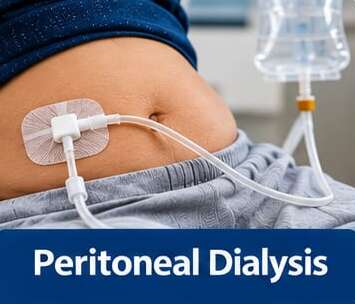
Peritoneal dialysis utilizes the peritoneum, the lining of the abdominal cavity, as a natural filter for blood. In this procedure, sterile dialysis fluid, or dialysate, is introduced into the abdominal cavity through a catheter, allowing it to absorb waste and excess fluid from the bloodstream. After a designated dwell time, the fluid is drained and replaced with a new batch. This process can be conducted manually several times throughout the day (Continuous Ambulatory Peritoneal Dialysis, CAPD) or via a machine at night (Continuous Cyclic Peritoneal Dialysis, CCPD). PD is commonly performed in a home setting, providing patients with enhanced flexibility in their daily routines.